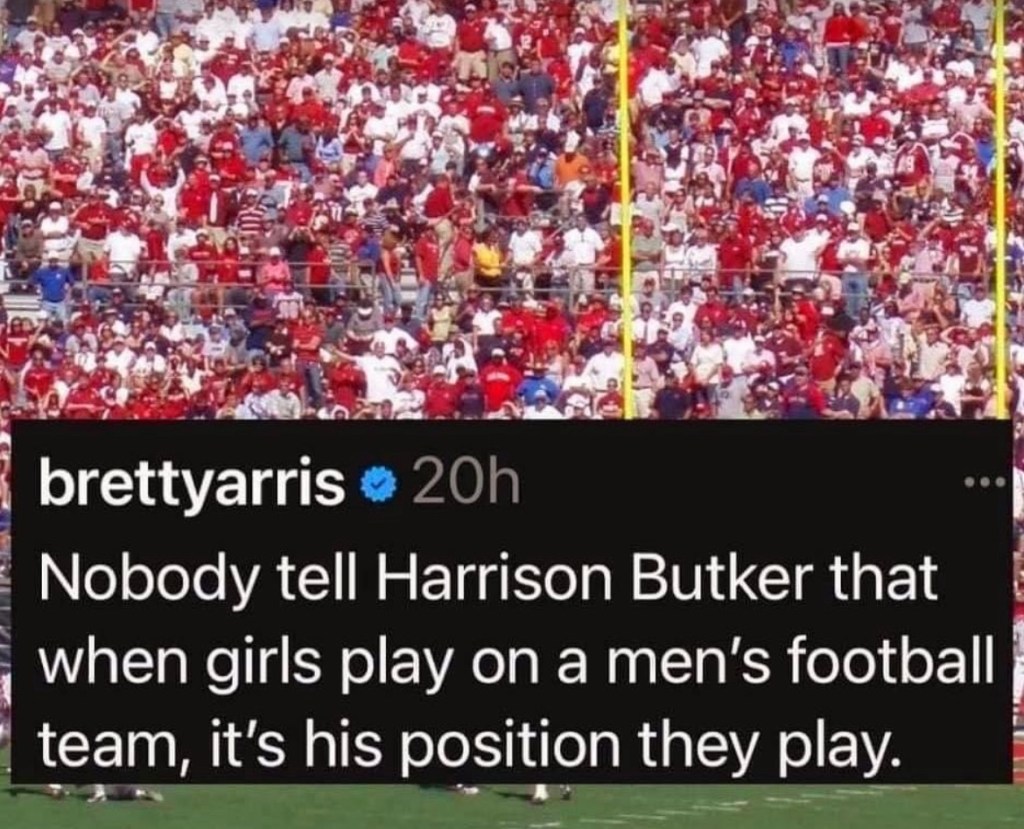
By now you’ve probably seen or heard clips from Harrison Butker’s commencement speech for the graduating class at Benedictine College, but in case you haven’t here’s a quick recap: Harrison Butker is a professional football player. He’s a kicker for the Kansas City Chiefs. He’s also an absolute twat, but we’ll get to that in a second. He was invited to deliver an address to the graduating class at Benedictine College, a Catholic liberal arts college in Atchison, Kansas on May 11. During this address, Butker made several controversial statements: a few highlights include ongoing derision of President Biden’s faith; some thinly veiled antisemitic rhetoric; and some not so thinly veiled transphobia. He also addressed the women in the audience, telling them that their worth as a human is based on their ability to produce children. He went on to tell the men in the audience to fight against “the cultural emasculation of men”.
No really, he did. Plus a whole lot more.
I could talk about how loud and wrong this guy has managed to be all day long. But I’m going to focus on one aspect of his (terrible) speech: the idea that women should measure their worth by their wombs.
First of all, and let’s get this out of the way so you can show yourself out if you don’t agree, not all women have wombs. Not all women have vaginas. Trans women are women. Being a woman is so much more than anatomy.
But for our purposes here, let’s assume that our buddy Harrison is addressing women who have the necessary biological equipment to carry children.
Valuing a woman based on her ability to bear children is WRONG. And it’s wrong on so many levels. My friend Lane does a great job of explaining why, and her TikTok video is what inspired this post (thanks Lane!). She’s smart and funny and has a lot to say, and you should spend some time perusing her channel.
The infertility community is not a monolith, just like the loss community isn’t. I can’t speak for everyone who’s lost a child, and I can’t speak for anyone who has experienced infertility, because I haven’t been in their shoes.
What I can do is dig deep, sit in empathy, and unpack why telling women that bearing and raising children is the pinnacle of female worth is so heinous. So let’s dig in.
First, we have to recognize that pregnancy is not a health neutral condition. It is, in fact, pretty damn dangerous. And while there are measures a person can take to reduce their risk (detailed in the linked article), it’s still hazardous to your health. This is especially true in the US, where many states have passed laws that make sensible reproductive healthcare hard to obtain.
It’s also important to note that not all pregnancies result in live births; miscarriage and stillbirth rates are significant in the US and worldwide. There are no guarantees that a pregnancy will lead to a child, even under the most optimal of circumstances, and multiple miscarriages are not uncommon.
Infertility is not uncommon either; about 9% of men and 11% of women in the US experience issues with fertility. Infertility can be caused by a number of factors: age, illness (current or prior), surgical procedures…the list goes on and on. And for a lot of people who experience infertility, there’s no one cause that can be pinpointed by doctors; they simply cannot produce living biological children.
Beyond an inability to bear children, some people simply don’t wish to have kids. And that’s a valid choice, regardless of why it’s made. If you’re not willing to commit a lifetime of financial, emotional, environmental, and physical support to a human being that you are 100% responsible for the first 18 years of their life, you absolutely should not have children. There is no moral imperative that makes people who reproduce somehow superior to those who don’t. There’s no need to populate the Earth with more people, and those who choose not to have kids aren’t selfish- they’re simply making a choice. That choice is valid, and it doesn’t detract from a person’s worth.
Butker addresses the women in the audience and asks them to consider a return to “traditional” values, where they marry a man and bear his children. Where they remain at home once these children are born, sacrificing their career goals for the “greater good” of American society. But where does the idea that women should become stay at home moms come from?
The US’s move toward a nuclear family in post World War II society put the onus of raising children on one person: the mother. Before the 1950s, families often lived in multigenerational homes where grandparents, parents, children, even aunts and uncles- all lived together, sharing the workload of raising kids, maintaining a home, and bringing in a living wage. World War II saw the advent of women working outside the home; as men left to fight overseas, women picked up the slack and supported the war effort (and their families) by working the jobs that their husbands, fathers, and brothers left when they enlisted. They discovered that it was possible to raise a family while working. When the men returned in the postwar era, women were displaced from the workforce. The idea of the nuclear family- a man, a woman, and 2.5 kids- took hold. This is the “return to values” that Harrison Butker and his ilk harp about: the “traditional” family that hasn’t even been the cultural norm for the majority of our country’s history.
When a parent chooses to step away from their career to raise a family, it’s a decision that impacts everyone. The family is reduced to one income, which often puts financial strain on the breadwinner- especially in today’s current economic climate. It also puts the person who stays home at a disadvantage- their earning power is greatly diminished by the lapse in employment, and they have no income to rely on should the partnership dissolve. This puts women who stay at home at risk because they lack independence. In an unhappy marriage, financial abuse is an easy way to control one’s partner. Women who stay at home may not feel like they can leave an abusive marriage- they can’t financially support their children without their partner’s help and may not even have enough money to make a clean break. Many women worry that they won’t be able to afford a divorce lawyer, and that their ex will take custody of their children.
These very real concerns- loss of health and even life, loss of career, and loss of independence- are valid and empirically proven. So why is there such an emphasis placed on the nobility of such sacrifices?
The simple answer: control. The religious and political institutions that Butker values are all about control. It’s clear in their ideologies: controlling a person’s right to reproductive healthcare is only one facet of their overall desire to enforce their moral code on an entire culture. There is no federally-protected, paid leave for new parents. Sure, there’s FMLA, but every state is allowed to determine whether companies are required to pay benefits to new parents, with few choosing to allocate funding to keeping new families financially afloat while they bond with their children. The lack of state-supported, affordable, and safe childcare is another problem that conservative and religious organizations tend to dismiss. When childcare costs more than a parent can possibly earn, the decision to stay home becomes the only possible financial choice.
Are people who experience miscarriage, multiple miscarriages, and/or infertility any less important? Are they somehow less worthy of love and acceptance? Beyond that, are people who choose not to reproduce somehow morally inferior to those who choose to become parents? Harrison Butker would have you believe that their inherent worth as a human being is diminished by an inability or lack of desire to crap out a kid. His statements, based on a warped understanding of “traditional” family roles and a lack of critical thinking skills, clearly define women as valuable based on their ability to bear and raise children. I’m here to tell you that simply isn’t true. Everyone has worth simply by merit of existing. Your desire and ability to have children do not define you as a person. To reduce anyone to such basic and arbitrary qualifications is morally repugnant and intellectually baseless.

 Missing Mina
Leave a comment